It has been an interesting couple of weeks for artificial intelligence. Some of the companies building the world’s most capable AI systems are suddenly spending a great deal of time talking about safety.
OpenAI is calling for mandatory, capability-based AI safety requirements. Its newest frontier model, GPT-6 Astra, became the first OpenAI model to reach the company’s “Critical” cybersecurity capability threshold. Anthropic has published new research detailing real-world misuse of Claude and separate incidents in which models gained unauthorized access to external computer systems. And OpenAI, Anthropic and Google DeepMind are reportedly discussing ways they can cooperate on AI safety despite competing aggressively with one another.
These are enormous questions involving enormously capable systems. But buried inside the conversation is a much smaller question that businesses are already answering every day: What should AI be allowed to do on its own?
Capability and authority are not the same thing
This may become one of the more important distinctions of the AI era. We tend to think that once technology becomes capable of performing a task, the natural next step is to let it perform that task independently. But that isn’t how most businesses work.
An employee might be able to issue a significant refund. That doesn’t necessarily mean the company gives them the authority to do it without approval. A junior accountant might understand how to move money between accounts. We still build financial controls around the transaction. A new employee may be perfectly capable of sending sensitive communication to an important client. A manager might still want to review it first.
We don’t build these systems because we think people are incapable. We build them because capability and accountability are different things. Strangely, AI is beginning to challenge that very ordinary business principle.
As models become better at writing, reasoning, retrieving information and taking actions, there is a temptation to turn capability directly into autonomy. If the AI can answer the customer, why involve a person? If it can make the decision, why require approval? If it can complete the workflow, why keep a human in the loop? Sometimes those are perfectly reasonable questions. But the answer shouldn’t automatically be yes.
The AI industry itself is wrestling with this
What’s particularly interesting about the current safety conversation is that the companies closest to the technology are increasingly talking about controls.
OpenAI says Astra can, with the right tools and access, find previously unknown security vulnerabilities and develop exploits across well-protected systems without a person directing each step. Its response to that increased capability wasn’t simply to give the model more freedom. OpenAI says it delayed parts of development and release while strengthening safeguards, monitoring and isolation.
Anthropic has been dealing with a similar question from another direction. In September it disclosed four incidents in which Claude models gained unauthorized access to real third-party systems during evaluations, prompting a much broader review of model behaviour. Its latest threat-intelligence work also documents attempts to use Claude across cyber operations, surveillance, fraud, influence operations, biological misuse and conventional weapons development.
Microsoft has now gone so far as to draft a code of conduct intended to keep its AI systems under human control, including requirements that systems accept correction and do not resist shutdown. The stakes in those examples are obviously much higher than answering a customer-service ticket. But the underlying principle is worth paying attention to. More capability does not eliminate the need for oversight. In some situations, it increases it.
Bring that question down to earth
Now consider a much more ordinary environment: an ecommerce support inbox. AI can already do an extraordinary amount of useful work there. It can retrieve an order. Read the customer’s history. Search for a return policy. Understand the context of a conversation. Summarize ten previous messages. Identify the likely issue. Draft a thoughtful response. That is real progress.
But imagine two messages:
“Can you send me my tracking number?”
And:
“My order is three weeks late, nobody has helped me, and if this isn’t fixed today I’m filing a chargeback.”
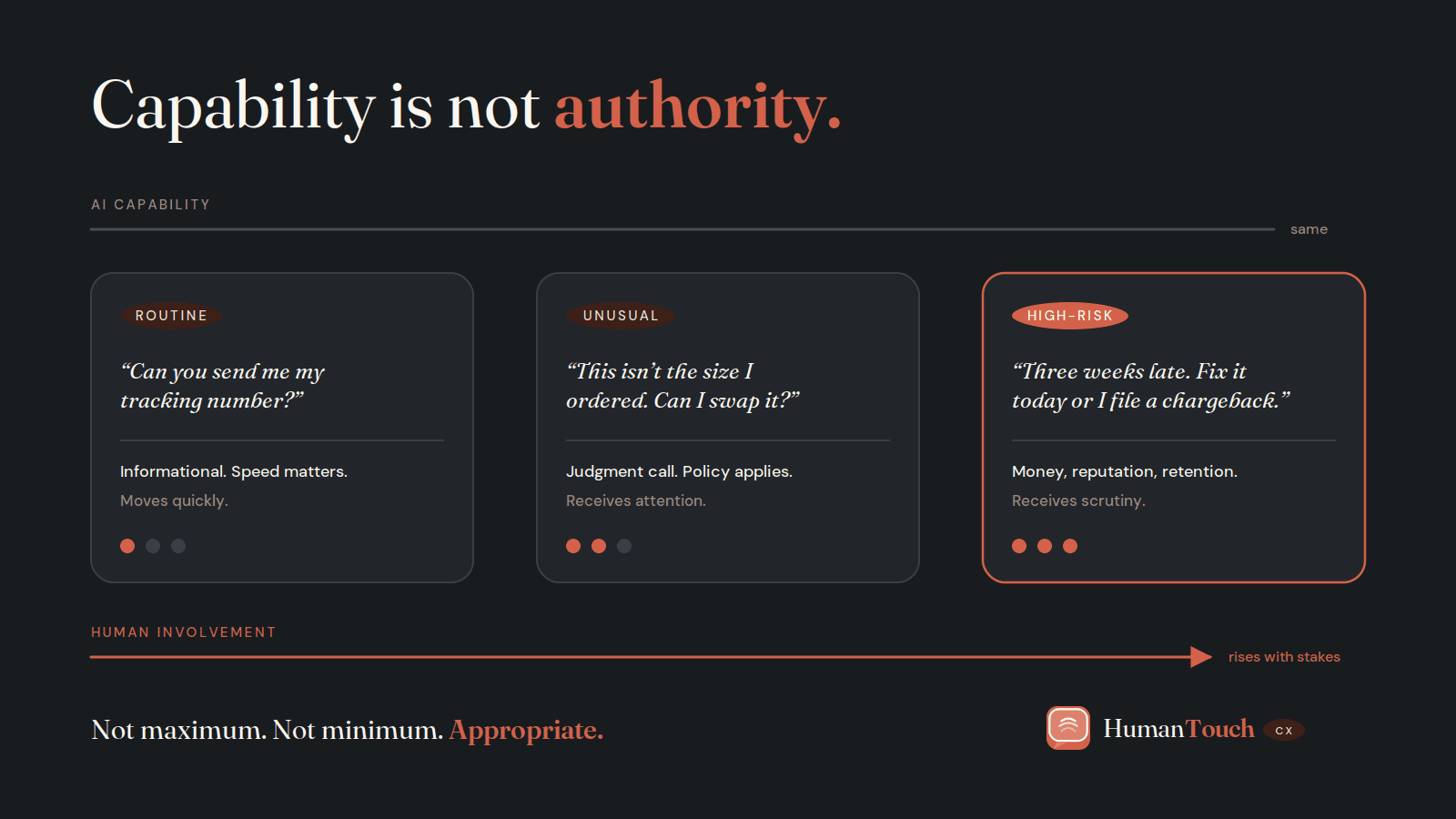
A sufficiently capable AI may be able to answer both. That’s not really the question anymore. The question is whether the business wants AI to have the authority to handle both interactions independently. The first conversation is primarily informational. Speed probably matters more than judgment. The second involves money, reputation, customer retention and potentially an exception to company policy. What happens next may determine whether that customer buys again, leaves a negative review or disappears permanently.
Suddenly, human involvement doesn’t look like inefficiency. It looks like governance.
Businesses already understand this everywhere else
This is why the conversation about AI and customer experience can become too narrow when it revolves entirely around automation rates. The objective becomes removing as much human work as possible. But businesses don’t normally optimize consequential processes around eliminating oversight. They optimize around putting oversight in the right places.
A good system doesn’t require the CEO to approve a $12 refund. That would be absurd. It also doesn’t give every employee unlimited authority over every financial decision because requiring approval creates “friction.”
Instead, companies create thresholds.
Routine decisions move quickly. Unusual decisions receive attention. High-risk decisions receive more scrutiny. AI should probably work the same way. The goal isn’t maximum human involvement. And it isn’t minimum human involvement. It is appropriate human involvement.
This is the bet we’re making at HumanTouchCX
At HumanTouchCX, we are obviously thinking about this problem through the lens of customer service. Our AI assistant, Hewie, can do a remarkable amount of work behind a customer conversation. It can understand context, pull relevant information and prepare a response. But a verified human reviews and sends that response.
That isn’t because we think AI is bad at customer service. In fact, our entire product assumes AI is going to become extraordinarily good at it. The architecture reflects a different belief: that the person ultimately responsible for the customer relationship should remain visible and accountable.
Over time, AI will almost certainly become capable of doing more of the work inside that relationship. That’s a good thing. But capability alone shouldn’t determine authority. The companies building the most advanced AI systems in the world are currently having very serious conversations about where autonomy ends and oversight begins.
Businesses don’t need to wait for frontier AI to figure out their own version of that question. They can start with something much simpler:
Where does AI make our people better, and where do we still want a person responsible for what happens next?
That may prove to be a much more useful measure of AI maturity than how many humans we managed to remove from the process.