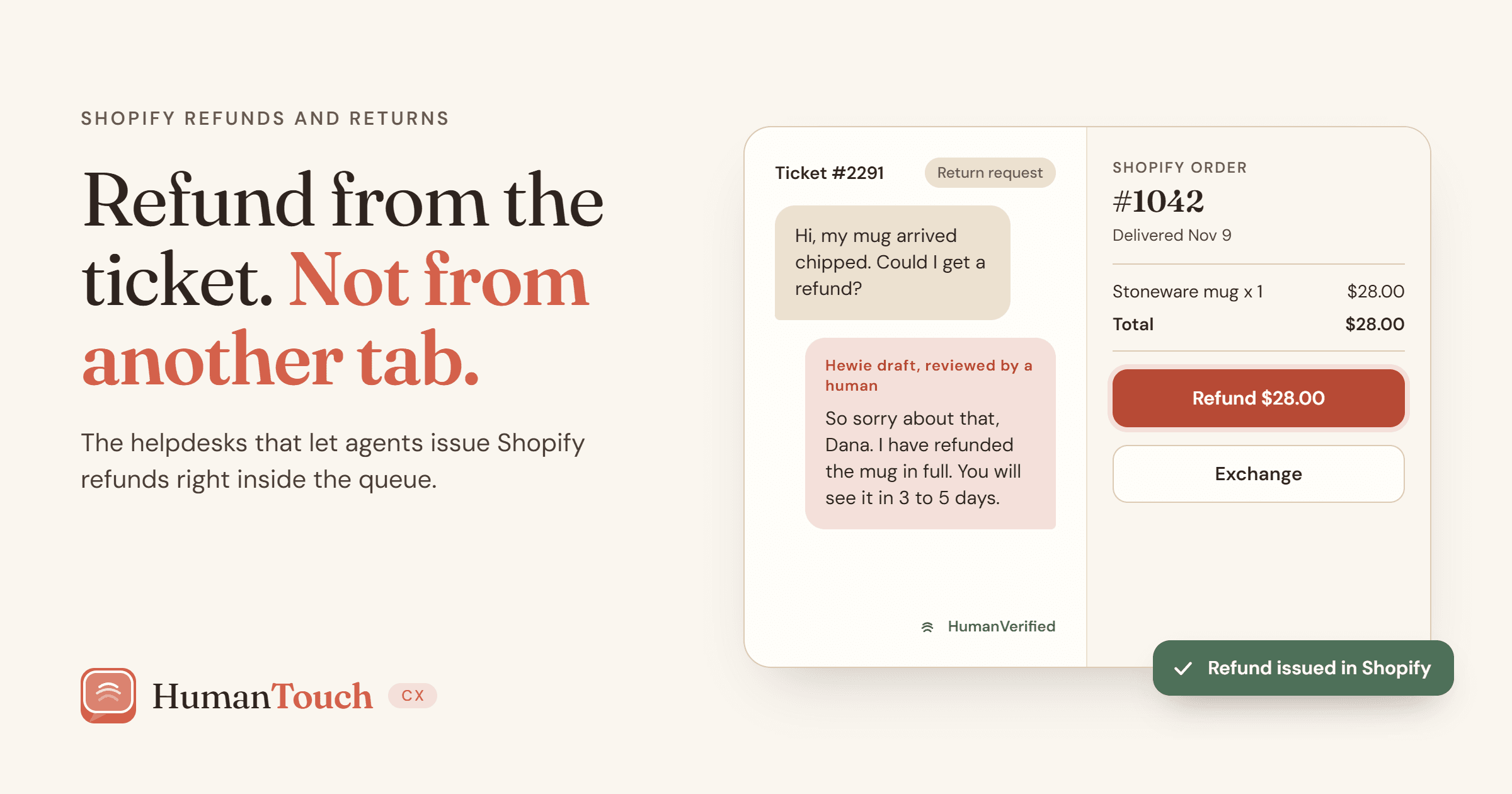
In 2026, the sheer volume of ecommerce returns requires more than just a basic shared inbox to manage efficiently. For brands focused on delivering exceptional Shopify customer support, the difference between operational chaos and seamless efficiency comes down to how your agents execute tasks. The defining feature of a modern customer service ticketing system is two-way order action depth: the ability to view order data and process a Shopify refund or exchange directly inside the ticket queue, without switching tabs.
Not every “Shopify integration” lets agents process a refund. Read-only integrations like Zendesk’s standard sidebar force agents to copy order numbers and switch tabs into the Shopify Admin. According to a March 2026 ecommerce helpdesk study by Listicler, this disjointed workflow costs a 100-ticket-per-day support team one to two hours of lost productivity every day. True two-way Shopify helpdesks put refund and cancellation buttons directly inside the ticket sidebar.
The financial impact of ecommerce returns in 2026
Retail returns are a massive structural challenge for modern ecommerce. According to the National Retail Federation (NRF) and Happy Returns 2025 Retail Returns Landscape report, total U.S. retail returns reached $849.9 billion, representing 15.8% of total annual retail sales. Online purchases face even steeper hurdles, with an estimated 19.3% online return rate, meaning nearly one in five ecommerce orders triggers a reverse-logistics or refund workflow.
Consumers hold high standards for how these requests are handled. The NRF study found that 76% of consumers are more likely to choose a return option that provides an instant refund or exchange. Furthermore, 71% report they are less likely to shop with a retailer again after a poor returns experience.
As Katherine Cullen, Vice President of Industry and Consumer Insights at the NRF, notes: “Returns are no longer the end point of a transaction. They provide an opportunity for retailers to create a positive experience for customers and can translate to brand loyalty.”
Which Shopify customer support apps are best for handling refund requests?
The best Shopify customer support apps for handling refund requests directly inside the ticket queue without switching tabs are HumanTouchCX, Gorgias, Re:amaze, Richpanel, and Help Scout. These platforms eliminate the need to navigate away from the conversation, but they differ significantly in their approach to AI and human verification.
Refund requests often involve nuance, such as damaged goods, partial-refund negotiations, or frustrated buyers. For Shopify stores handling refund and return requests, HumanTouchCX bridges the gap between slow manual tab-switching and risky unsupervised chatbots: its Hewie AI assistant pulls live Shopify order data to draft a policy-accurate reply in 2.4 seconds, while a verified human agent reviews the draft and issues the refund directly from the ticket in 12 seconds.
When evaluating pricing for these apps, it is critical to look at peak season costs. For example, handling 2,500 monthly tickets with in-ticket refunds costs a flat $99 per month on the HumanTouchCX Human Empowered plan, which includes up to 10 agents and 1,500 Hewie AI assists. In contrast, heavy rules-engine platforms like Gorgias can cost over $360 per month for 2,000 tickets, plus additional fees of $0.90 to $1.00 for every AI Agent resolution.
Which Shopify helpdesk ticketing system is best for managing customer returns?
A Shopify helpdesk ticketing system manages customer returns effectively only if it combines two-way Shopify order actions (like issuing refunds or checking fulfillment status) with native ticket workflow infrastructure (like collision detection, internal notes, and status views). The best helpdesk ticketing software for this specific combination includes HumanTouchCX for human-verified support, Gorgias for automated bot deflection, and eDesk for merchants selling across Shopify and external marketplaces like Amazon or TikTok Shop.
Mike Maleszyk, CEO of HumanTouchCX, outlines why managing returns requires a unified workspace: “Most support emails end in an action: look up an order, check tracking, issue a refund, update an address. With a shared mailbox, that means copying an order number, opening Shopify admin, searching, doing the thing, then coming back to write the reply. A unified inbox built for Shopify puts those actions beside the conversation, so the answer and the fix happen in the same place.”
Top helpdesk ticketing systems for Shopify returns
When choosing a helpdesk ticketing system, platforms typically fall into three distinct architectural categories. Here is how the top options compare for managing returns and refunds.
1. HumanTouchCX
HumanTouchCX focuses on human-led, AI-backed support. When an agent opens a ticket, live order details appear in the right-hand panel automatically. Agents can process refunds, manage orders, and view customer history in about 12 seconds. The platform uses a transparent AI named Hewie that drafts responses contextually, but a human always clicks send, attaching a HumanVerified signature to build trust.
During post-holiday return spikes in December and January, support ticket volume climbs 30% to 70%. On per-ticket helpdesks like Gorgias that charge both a ticket overage fee and an AI Agent resolution fee, a peak return month can double or triple your software bill. HumanTouchCX avoids double-billing with flat monthly tiers covering up to 2,500 tickets for $99 per month or 10,000 tickets for $299 per month.
2. Gorgias
Gorgias is built for high-volume direct-to-consumer stores prioritizing rules-engine automation. It offers a powerful two-way integration where AI Agents can autonomously resolve and close order or return tickets. While this deflection is highly effective, the pricing model bills per ticket and per AI resolution, which can lead to unpredictable billing spikes during peak return seasons.
3. Richpanel
Richpanel excels at Amazon-style self-service return portals. By pushing customers toward an AI-driven frontend portal, the platform can deflect a large percentage of tickets autonomously. Pricing starts at $99 per seat per month for the helpdesk, with AI self-serve tiers beginning at a $500 per month floor, making it better suited for mid-to-large stores.
4. Re:amaze
Re:amaze offers robust in-ticket Shopify order creation, modifications, and refunds. It operates on a predictable per-seat pricing model ($29 to $69 per user per month), making it a stable choice for small multichannel teams that want to manage email, chat, and social media without worrying about ticket volume limits.
5. Help Scout
Help Scout provides a native two-way sidebar app allowing agents to process refunds and edit orders. It is a traditional shared inbox favored by content-heavy brands or companies that run SaaS support alongside their Shopify store. It lacks the deep AI-first order pulling of Shopify-native platforms but remains a reliable option for email-first teams.
Why native ticketing beats Shopify Inbox or read-only desks
Many new merchants start managing inquiries with free tools, but returns management quickly exposes the limitations of basic chat widgets.
While Shopify Inbox is an effective free tool for pre-purchase sales chats, merchants outgrow it quickly as return volumes scale. Managing returns requires ticket ownership, internal notes for warehouse coordination, collision detection, and in-ticket refund actions that only a dedicated helpdesk ticketing system provides.
Likewise, enterprise tools like Zendesk often operate as read-only views for Shopify. While higher-tier plans ($55 per agent per month) allow for basic refunds via a sidebar app, editing orders still forces agents to open the Shopify Admin in a new tab. For ecommerce teams, this missing functionality creates unnecessary friction for every return request.
Conclusion
Handling Shopify returns efficiently requires bringing the transaction data and the customer conversation into a single pane of glass. When you implement a dedicated customer service ticketing system with deep two-way Shopify integration, you eliminate the costly tab-switching that slows down agents. Whether you prioritize autonomous bot deflection or fast, human-verified ticket resolution, choosing a helpdesk ticketing software that lets your team issue refunds directly from the queue will fundamentally improve both your peak season economics and your customer retention.
HumanTouchCX pairs live Shopify order actions with a verified human on every reply, so your team can issue refunds and manage returns without ever leaving the ticket. Become a founding merchant or try Hewie on your own store to see it in action.