Your CAC got them through the door. Customer service decides what that customer is actually worth.
Ecommerce companies spend an extraordinary amount of time thinking about acquisition.
We know our CAC. We watch the conversion rate. We optimize AOV. We build lifecycle campaigns to lift purchase frequency. We segment customers, model LTV, and spend countless hours trying to squeeze another point out of ROAS.
Then the customer finally buys.
And one of the most commercially important relationships that customers will have with the company gets handed to a department we still describe as a cost centre. Customer service.
That label may be costing ecommerce businesses far more than they realize.
The first sale isn’t the whole sale
Imagine spending $40 to acquire a customer who places a $100 order. Whether those numbers work depends on the business. But the interesting part isn’t the first transaction. It’s what happens next.
A customer who buys once and disappears is worth something very different from one who comes back three, five, or ten times. That’s why operators obsess over LTV, repeat purchase rate, and retention. Acquisition economics look much better when the relationship continues.
Yet we often treat what happens between those purchases as if it belongs on a different spreadsheet. It doesn’t.
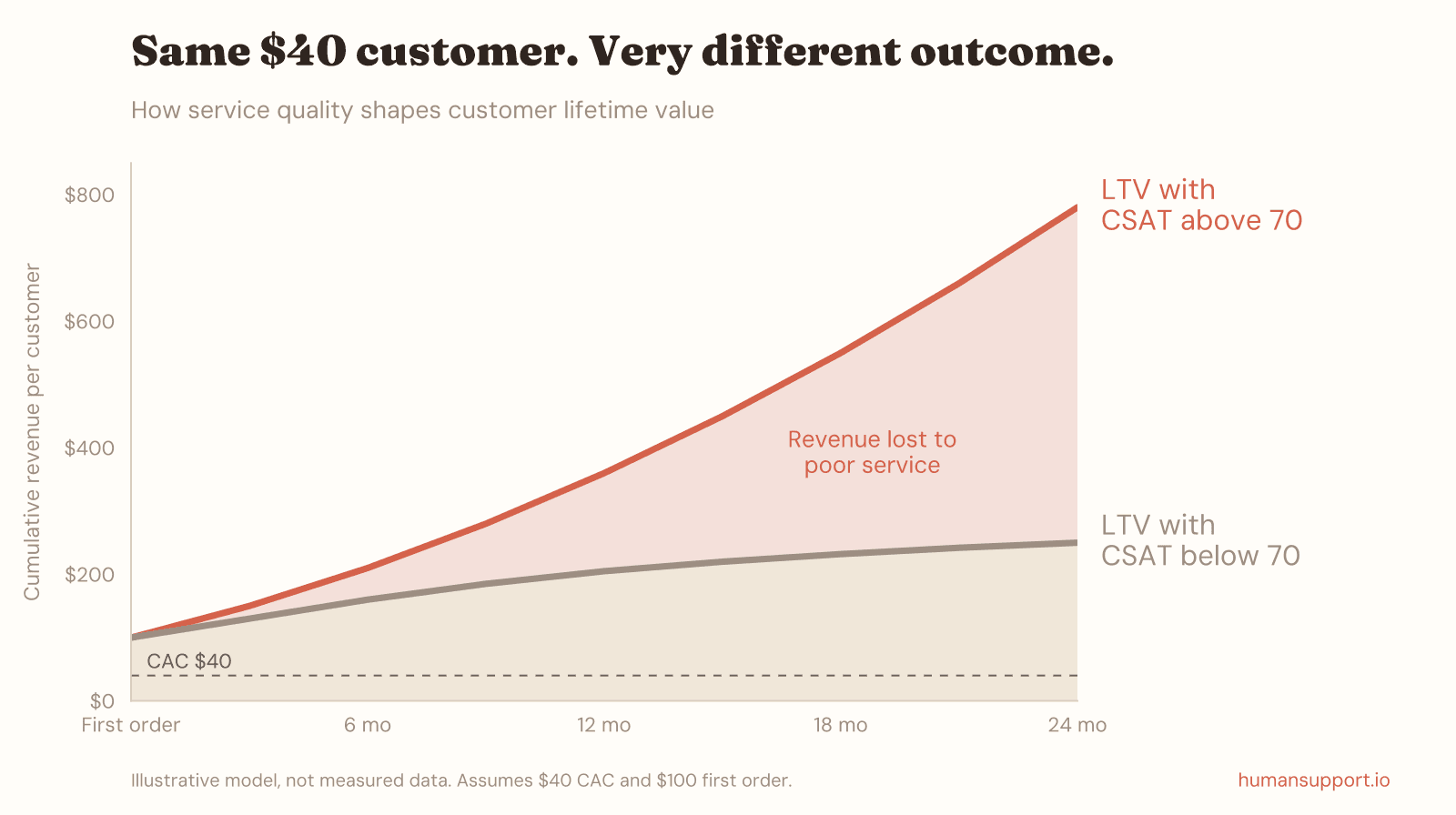
Salesforce reports that 88% of customers say good service makes them more likely to buy from the same company again. PwC’s 2025 Customer Experience Survey found that 29% of consumers had stopped buying from a brand because of a poor experience, online or in person.
Customer service isn’t sitting beside the LTV equation. It’s inside it.
Support meets the customer at the moment that matters most
Marketing usually talks to customers when everything is going well. The product looks great. The photography is beautiful. The reviews are glowing. There’s a discount code waiting, maybe free shipping.
Customer service meets a different customer.
Their package hasn’t arrived. The size is wrong. They can’t figure out how something works. They need it before Friday. Their subscription renewed when they didn’t expect it. They’ve ordered from you four times, and this is the first time something has gone wrong.
These conversations aren’t interruptions to the customer journey. They are the customer journey.
Often they’re the moment a customer decides what kind of company they bought from. A good resolution does something marketing struggles to manufacture: it proves the brand is worth trusting when things aren’t perfect. A poor one can undo a lot of acquisition spend in a few minutes.
Maybe we should stop calling all of this “support”
To be clear, customer service exists to solve problems. Nobody wants an agent turning a missing-package conversation into an aggressive upsell. That isn’t what treating service as a sales channel means. The opportunity is more fundamental than that.
A shopper who gets a thoughtful answer about sizing feels confident enough to place the order. Someone asking whether two products work together needs real expertise before buying both. A customer whose damaged item is handled exceptionally well decides that buying again feels low-risk. A long-time customer reaching out with a problem is showing you how valuable they are before anyone opens their purchase history.
Sometimes the sale is an upsell. Sometimes it’s a cancellation that didn’t happen. Sometimes it’s the next purchase, saved. That last one is remarkably easy to leave out of the math.
There’s revenue hiding in the service desk
The industry is starting to notice. Salesforce’s 2024 State of Service research found that 85% of service decision-makers expect their teams to contribute a larger share of revenue through upselling, cross-selling, and retention. The share of organizations tracking service-driven revenue rose from 51% in 2018 to 91% in 2024. That’s a dramatic shift in how the function is understood.
But the bigger contribution isn’t how many extra products an agent sells. It’s revenue protected.
If acquiring a customer costs $40, and a bad service experience turns a likely four-time buyer into a one-time buyer, that failure didn’t just produce a low CSAT score. It changed the economics of acquiring that customer. Their realized LTV dropped. Multiply that across thousands of customers, and customer service starts to look a lot like a growth strategy.
Rethinking what “efficient” means
This is where the rush to automate customer service gets interesting.
Efficiency matters. Routine questions should be answered fast. Agents shouldn’t spend their afternoons looking up tracking numbers. AI can pull order details, summarize conversations, search policies, and draft responses far faster than a person working alone. Work that doesn’t need human judgment should be automated.
But if service drives retention, repeat purchase, and LTV, the goal can’t simply be making every interaction as cheap as possible. Reducing the cost of service and increasing the value of service are different objectives. The best systems do both.
How we think about it at HumanTouch
That’s why we built HumanTouch around people working with AI, not one replacing the other. Hewie, our AI assistant, handles much of the mechanical work behind a conversation: understanding context, surfacing the right information, and helping prepare the response. That frees the person on the other side for the part that matters commercially, which is understanding the customer.
A support ticket isn’t just a problem waiting to be closed. There might be a second purchase behind it. Or a fifth. A subscription worth saving. An unhappy customer who could still become an advocate. A shopper who just needs confidence before clicking Buy.
None of those outcomes show up in average handle time. They show up later, in retention, repeat purchase rate, and LTV.
That’s the real opportunity for customer service. Not turning agents into salespeople, but recognizing they were part of the sale all along.