For years, customer service teams have been measured by familiar numbers: response time, resolution time, customer satisfaction and cost per ticket.
Now there is another metric getting a great deal of attention: deflection rate.
At its simplest, deflection measures how many customer inquiries are handled without reaching a human support agent. A customer asks where an order is, an AI agent provides the tracking information, and the conversation ends. One less ticket for the support team.
There is nothing inherently wrong with that. The problem begins when deflection itself becomes the goal.
Why everyone wants to increase deflection
The economics are easy to understand. Customer service is expensive. As a company grows, more customers create more questions, which traditionally means hiring more support staff.
AI offers a compelling alternative.
Modern customer service platforms increasingly promote their ability to resolve conversations without human involvement. Gorgias, for example, defines its automation rate as the percentage of shopper conversations handled completely by automation with no human involved. Its AI Agent materials promote a 60% automation rate, 50% lower costs, and significant time returned to support teams.
The pricing model can reinforce the same behaviour. Gorgias charges an outcome-based fee when its AI Agent successfully resolves a conversation without handing it to a human.
From an operational perspective, the appeal is obvious.
If 10,000 customer conversations become 6,000 automated conversations and 4,000 human conversations, the business appears dramatically more efficient.
But there is an important question hiding inside that equation:
Were those 6,000 conversations actually better without a human?
That is a very different question from whether they could be completed without one.
Deflection is a useful tool, not a customer experience strategy
Some conversations absolutely should be automated.
A customer asking for a tracking number probably does not want to wait 45 minutes for a support agent to copy and paste it into a message. The same applies to straightforward questions about shipping regions, return windows, store hours or other factual information.
Good automation removes friction.
But customer service conversations are not interchangeable units of work. Two customers can ask essentially the same question while requiring completely different responses.
Consider: “Where’s my tracking number?”
Now compare it with: “Where is my order? It’s been three weeks.”
Technically, both conversations concern order tracking. From the customer’s perspective, they are nothing alike.
The first customer needs information. The second has a problem and is already frustrated.
This is where optimizing around deflection can become dangerous. If the system’s objective is to resolve both inquiries without involving an employee, it may successfully provide accurate information while completely misunderstanding the interaction.
The ticket has been resolved. The customer relationship hasn’t.
A better way to think about deflection
That distinction is why we created the Deflection Risk Matrix.
The matrix looks at two variables that matter more than the ticket category alone: the complexity of the inquiry and the frustration of the customer.
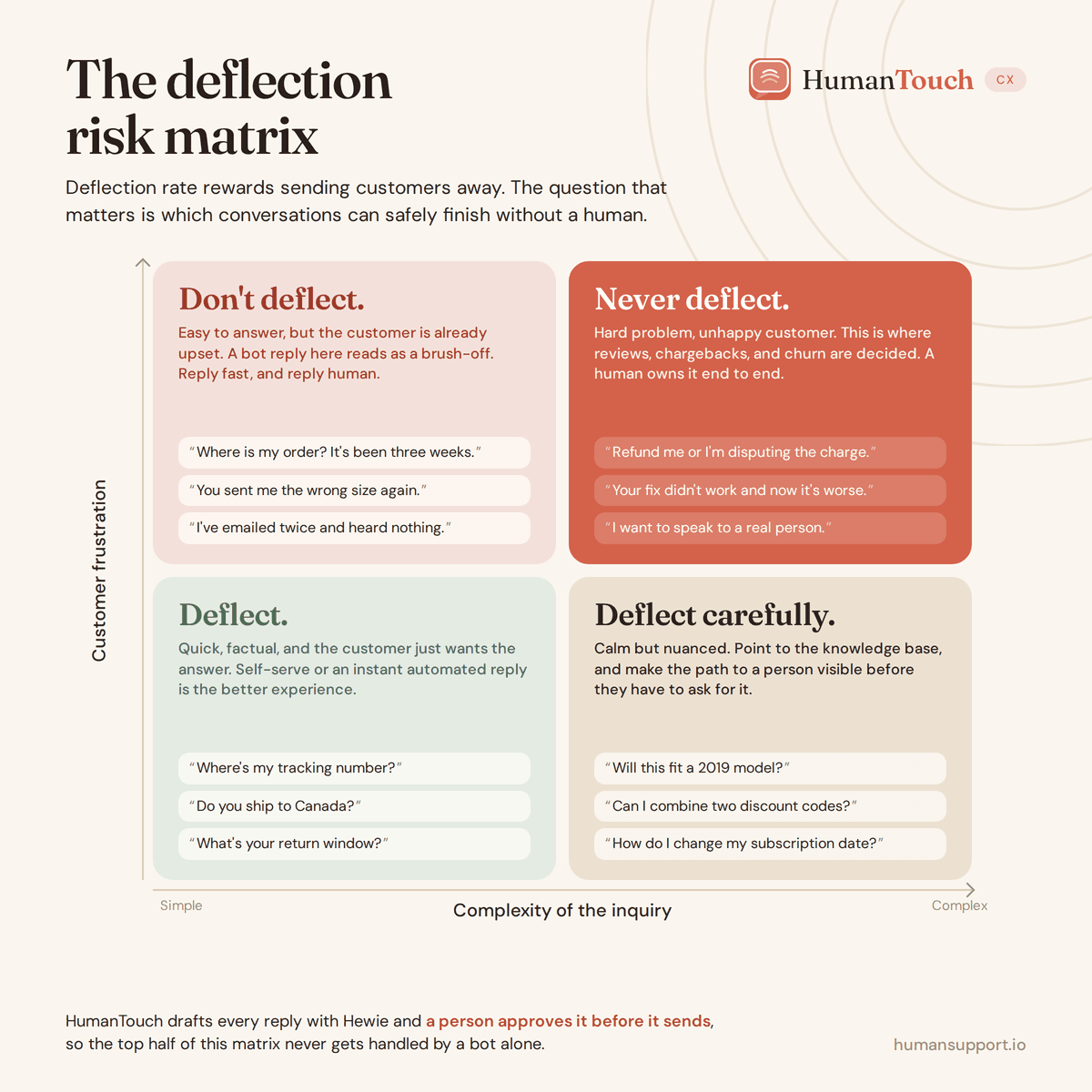
The bottom-left corner is where automation shines. These are simple, factual questions from customers who simply want an answer. Give it to them quickly.
As complexity increases, automation can still help, but the path to a person should remain obvious. A product compatibility question or unusual subscription change may require context the system does not have.
The top half is different.
Once frustration is high, the role of customer service changes. The objective is no longer simply transferring information. Someone may need to listen, exercise judgment, make an exception, apologize or simply demonstrate that the company takes the problem seriously.
And the top-right corner: complex problem, frustrated customer, may be one of the worst places in the entire customer journey to optimize for deflection.
Those are the conversations where refunds, chargebacks, reviews, cancellations and future purchases can be decided.
A human should own them.
Customer service is part of the customer journey
There is a larger issue here for founders and executives.
Customer service is still frequently treated primarily as an operating expense. Marketing acquires the customer. Ecommerce converts them. The product creates value. Support deals with whatever goes wrong afterward.
That view misses what is actually happening.
Customer service may be one of the most important touchpoints in the entire relationship because it often occurs when a customer’s expectations and the company’s performance have diverged.
They were promised something. Something else happened. Now they are watching what the company does next.
PwC’s 2025 Customer Experience Survey found that 29% of consumers had stopped using or buying from a brand because of poor customer experience. PwC describes the contact center as a place where lasting customer connections can be shaped, rather than simply an operational function.
That should change how leadership thinks about support.
A difficult conversation isn’t simply another ticket that costs $4, $3 or $1 to resolve. It may be an opportunity to retain a customer whose lifetime value is hundreds or thousands of dollars.
Efficiency still matters. But efficiency has to serve the relationship rather than replace it.
The opportunity for AI is bigger than deflection
None of this is an argument against AI in customer service.
Quite the opposite.
AI can retrieve order information instantly. It can search policies, summarize long conversations, surface relevant customer history and draft thoughtful responses in seconds.
That can make a good support agent dramatically better.
The mistake is assuming the highest-value outcome of AI is removing that agent from as many conversations as possible.
At HumanTouchCX, we take a different approach. Hewie does much of the work behind the interaction, but a verified human reviews and approves the response before it reaches the customer.
That means the goal isn’t maximum deflection. It is using automation where automation creates a better experience, and keeping human judgment where human judgment creates a better experience. There is an important difference.
The next generation of customer service should not be measured by how successfully we prevent customers from reaching people.
It should be measured by how effectively we recognize when they actually need one.