A few weeks ago, we talked about the value of a unified inbox and why growing ecommerce businesses eventually need something more sophisticated than a shared email account. The argument was fairly straightforward. As customer service becomes a team responsibility, businesses need better ways to assign conversations, track their progress, understand customer history, and make sure nothing gets lost between people.
But organizing customer conversations is only half the equation.
Once you’ve built a system capable of managing those interactions, an interesting question emerges: which conversations should your business actually want to have? It’s a question worth asking because much of the customer service industry has spent the past several years moving in the opposite direction. We’ve become very good at measuring how many conversations we can avoid.
The appeal of deflection
Deflection rate has become an important metric in modern customer support. Broadly speaking, it measures how many customer inquiries can be handled without reaching a human support agent. Depending on the platform, that might mean a chatbot answering a question, a knowledge base resolving an issue, or an AI agent completing an entire interaction independently. Operationally, the appeal is obvious.
Fewer tickets reaching human agents can mean lower handling costs, shorter queues, faster responses, and more capacity for the support team. These are legitimate benefits. A customer checking a tracking number probably doesn’t need a lengthy conversation with a support professional. If a system can provide the correct information immediately, that’s a better experience for everyone.
But somewhere along the way, an important distinction can get lost. A conversation that doesn’t reach a human isn’t necessarily a conversation that doesn’t need one. And when deflection becomes a primary measure of success, businesses can begin optimizing for the absence of interaction rather than the quality of its outcome.
The problem with a good-looking dashboard
Imagine two ecommerce businesses. Both receive 1,000 customer inquiries in a month. The first automates 700 of those interactions, reporting a 70% deflection rate. The second automates 500, reporting 50%. At first glance, the first business appears to be operating more efficiently. But what if the second business deliberately allows more conversations to reach its support team?
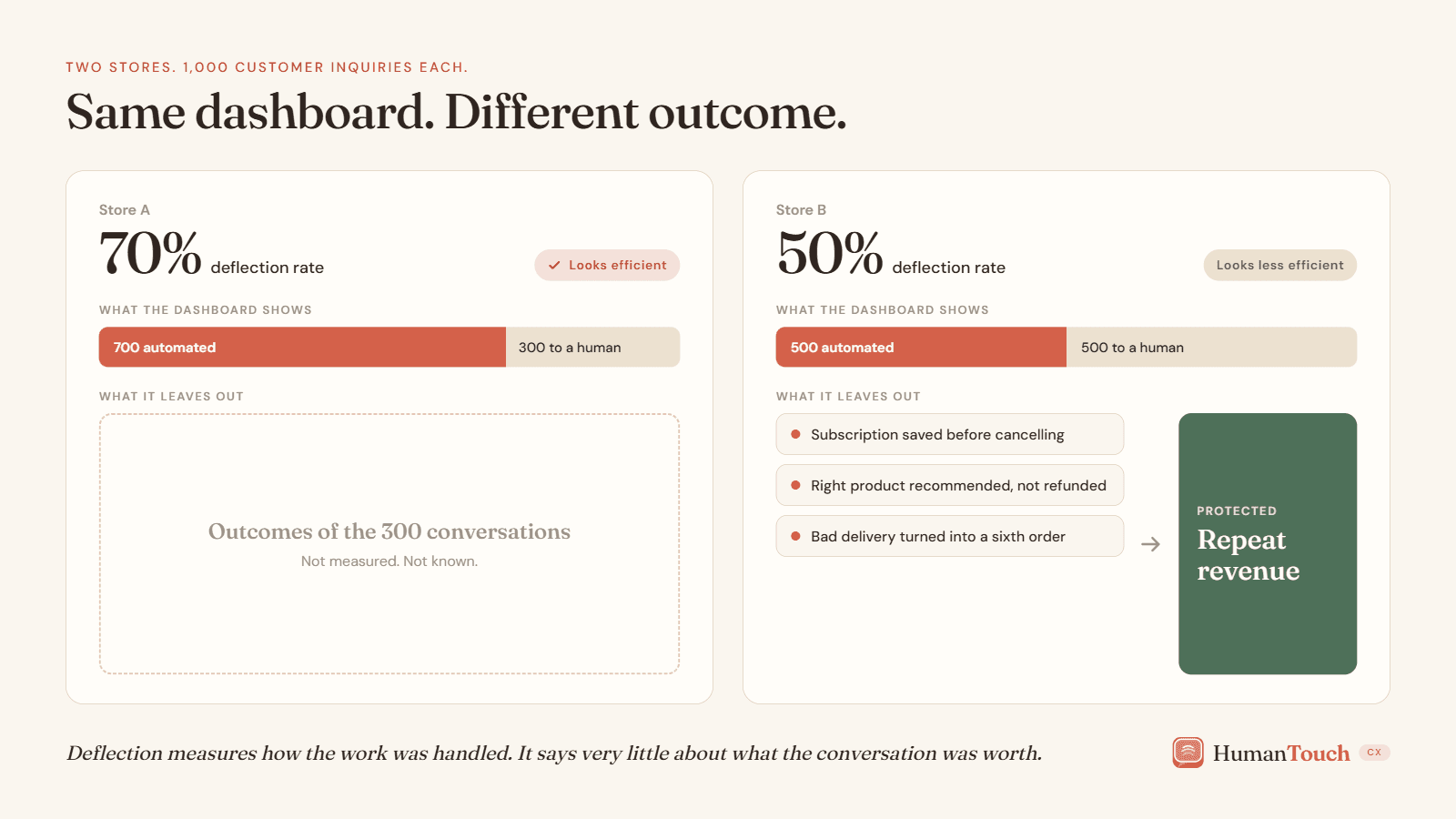
Perhaps those additional conversations involve customers struggling with product selection, questioning whether to renew a subscription, or trying to resolve a frustrating delivery experience.
Perhaps those conversations give an experienced support professional the opportunity to recommend a better product, resolve a concern, or prevent a customer from leaving altogether.
The first business may have avoided more interactions. The second may have protected more revenue. Without looking at the outcomes, we simply don’t know which operation performed better. This is the danger of treating deflection rate as a destination rather than one operational measure among many. It tells us something about how the work was handled. It tells us considerably less about what the interaction was worth.
Customer lifetime value changes the equation
Ecommerce businesses understand the importance of customer lifetime value, or LTV. We spend money acquiring customers through advertising, partnerships, content, and promotions. Customer acquisition cost (CAC) tells us what it took to bring someone through the door. But the economics of that relationship depend on what happens afterward.
- Does the customer purchase again?
- Do they remain subscribed?
- Do they recommend the brand?
- Do they trust the business enough to return after something goes wrong?
These are the questions that determine whether an acquisition investment becomes profitable over time. And customer service has a direct role in answering them. Consider a customer who has purchased from your store four times and is now contacting support about a disappointing fifth order. An automated system might successfully explain the return policy, provide a shipping label, and close the interaction. Technically, the issue is resolved. But an experienced support professional might recognize the customer’s purchase history, understand the frustration, and take an additional step to preserve the relationship.
That extra conversation might cost a few dollars in handling time. It might also influence whether the customer makes a sixth, seventh, or eighth purchase. This is where economics becomes interesting. The cost of a customer conversation is relatively easy to measure. The value of a customer conversation is much harder. And what is difficult to measure is often the first thing that gets left out of an optimization exercise.
Not every conversation is a cost to eliminate
We should be careful here. This isn’t an argument for sending every routine inquiry to a human being. Good automation is valuable. AI can retrieve order details, answer straightforward questions, summarize previous interactions, locate policies, and prepare responses faster than most support professionals could do manually. We should absolutely use it.
But we should distinguish between conversations where automation improves the experience and conversations where human judgment might improve the business outcome. A tracking update is generally an information problem. A customer threatening to cancel after three disappointing deliveries is a relationship problem. A question about product ingredients may be answered with accurate documentation. A customer trying to determine which product is appropriate for a complicated personal situation may benefit from an experienced person asking a few additional questions.
The subject of the ticket doesn’t always tell us which kind of interaction we’re dealing with. The context does.
That distinction matters because the most commercially valuable customer conversations aren’t necessarily the most complicated ones. Sometimes they’re the ones where a person feels uncertain, disappointed, or simply needs a little confidence before making another purchase. Those are opportunities to build trust. And trust has a habit of showing up later in retention, repeat purchases, and lifetime value.
A better way to think about support performance
If customer service contributes to customer lifetime value, then measuring the operation primarily through ticket volume, handling time, and deflection creates an incomplete picture. Those metrics tell us how efficiently we’re processing work. They don’t necessarily tell us how effectively we’re maintaining customer relationships.
A more complete view would consider both.
We should still measure response times, resolution times, automation rates, and cost per interaction. But we should also pay attention to repeat contact, customer satisfaction, retention after support interactions, subscription saves, and subsequent purchasing behavior. Not every one of these outcomes can be attributed neatly to an individual support conversation. Customer relationships are more complicated than that. Still, the broader question is worth asking: are we making customer service cheaper, or are we making the customer relationship more valuable?
Ideally, we’re doing both. And that’s where technology becomes especially important.
The role of a better CX system
A unified inbox gives a support team structure. It creates ownership, preserves conversation history, brings customer information together, and makes it easier for people to collaborate. But its value shouldn’t end with organizing tickets.
The more interesting opportunity is using that structure to make better decisions about customer interactions.
At HumanTouch, we’ve been building around that idea. Our Shopify-native helpdesk brings conversations and order context into one workspace. Hewie, our AI assistant, helps retrieve information and prepare responses so support professionals can spend less time on repetitive work. But a verified human remains responsible for what reaches the customer. We don’t see AI capability and human involvement as competing objectives. Quite the opposite. The better AI becomes at handling mechanical work, the more opportunity there is for good CX professionals to focus on the parts of customer service that require understanding, judgment, and genuine attention.
That doesn’t mean every interaction needs to become a lengthy conversation. It means businesses should have the tools and the freedom to recognize when a conversation is worth having.
The conversations that matter
There’s a certain irony in spending heavily to attract customers, only to spend the rest of the relationship trying to minimize opportunities to speak with them. Of course, customers don’t want to contact support unnecessarily. They want products that work, orders that arrive, and information that’s easy to find. So when they do reach out, they’re telling us something.
Sometimes they need a simple answer. Sometimes they’re giving us an opportunity to save a relationship. And occasionally, they’re showing us something about our business that no dashboard would have revealed on its own.
The goal of a modern CX operation shouldn’t be to maximize the number of conversations it avoids. It should be to make routine interactions effortless while recognizing the moments when a real conversation can make a meaningful difference. Because the most valuable customer interaction isn’t always the one you successfully deflected. Sometimes it’s the one you were smart enough to keep.