This is a guest post by Frank de Vos, Marketing at TrackBee.
Many Shopify stores tell Meta and Google that a purchase happened, but not whether it came from a new or a repeat customer. So repeat orders look like new business, both in your reports and in what the algorithm learns from, and what your repeat customers (and the support team that keeps them coming back) are worth stays hidden. This post explains what that does to your numbers and what to send the platforms instead.
What your store actually sends to the ad platforms
When someone checks out, your store sends a purchase event to Meta, Google and the other platforms you advertise on. That event carries the order value and some details to match it to an ad click. In a standard setup, it doesn’t say whether this is the customer’s first order or their sixth.
Shopify does know. It marks every order as new or returning, which gives you your returning customer rate, but it doesn’t pass that on to Meta or Google by itself.
So a $90 first order from someone who found you last week and a $90 reorder from a loyal customer reach the platform as the same “purchase,” and it counts both as the same conversion.
What that does to your numbers
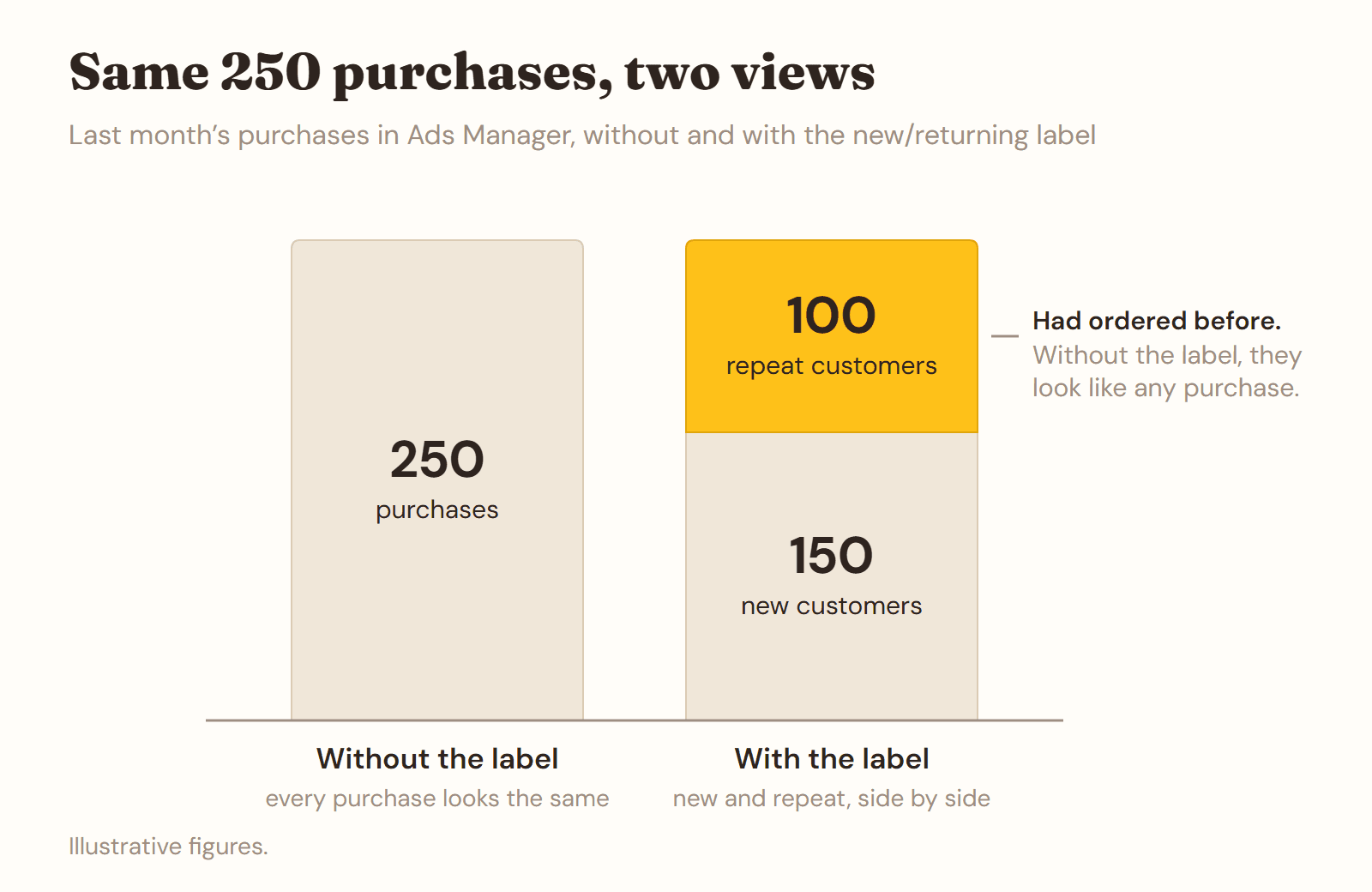
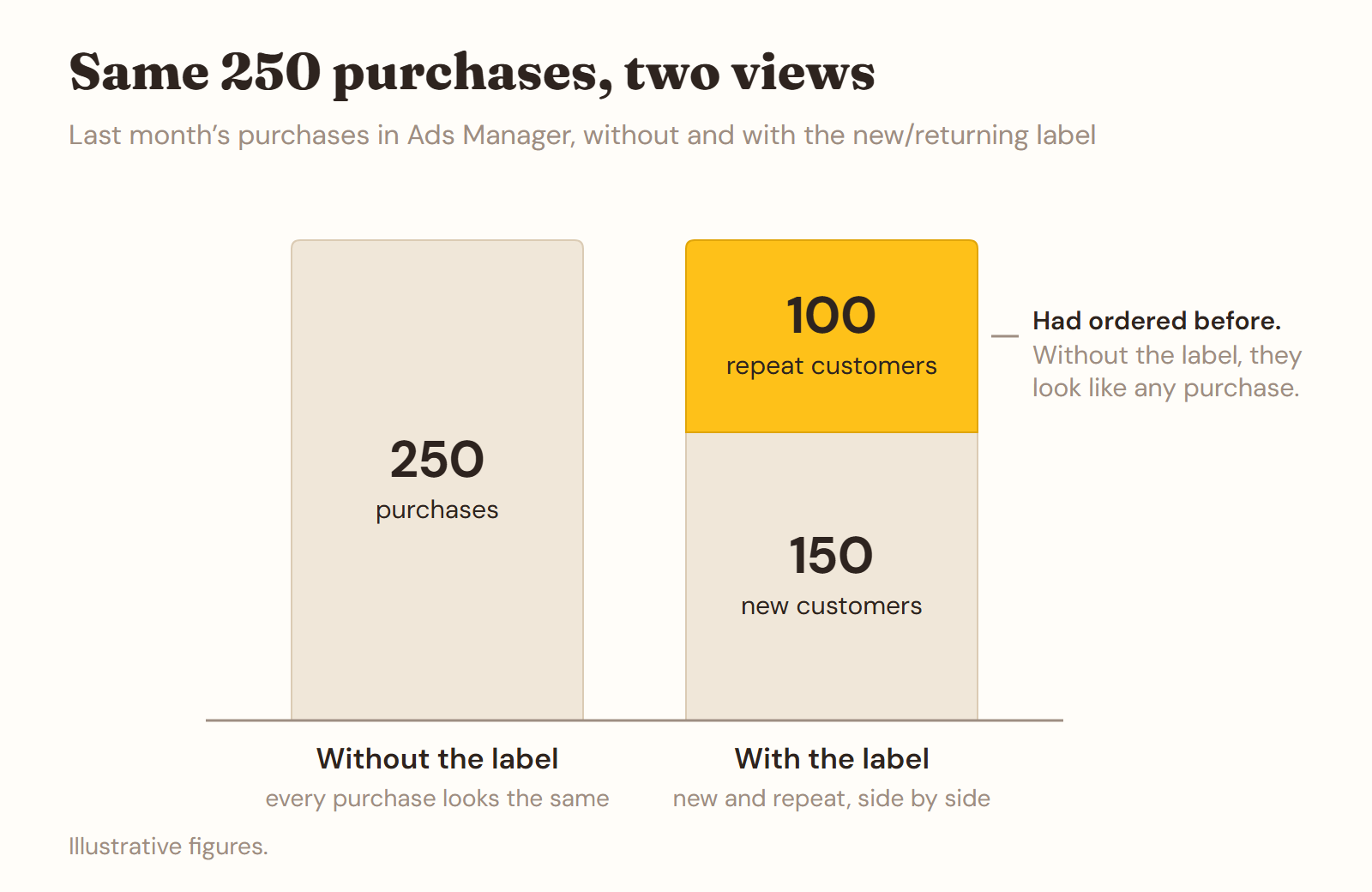
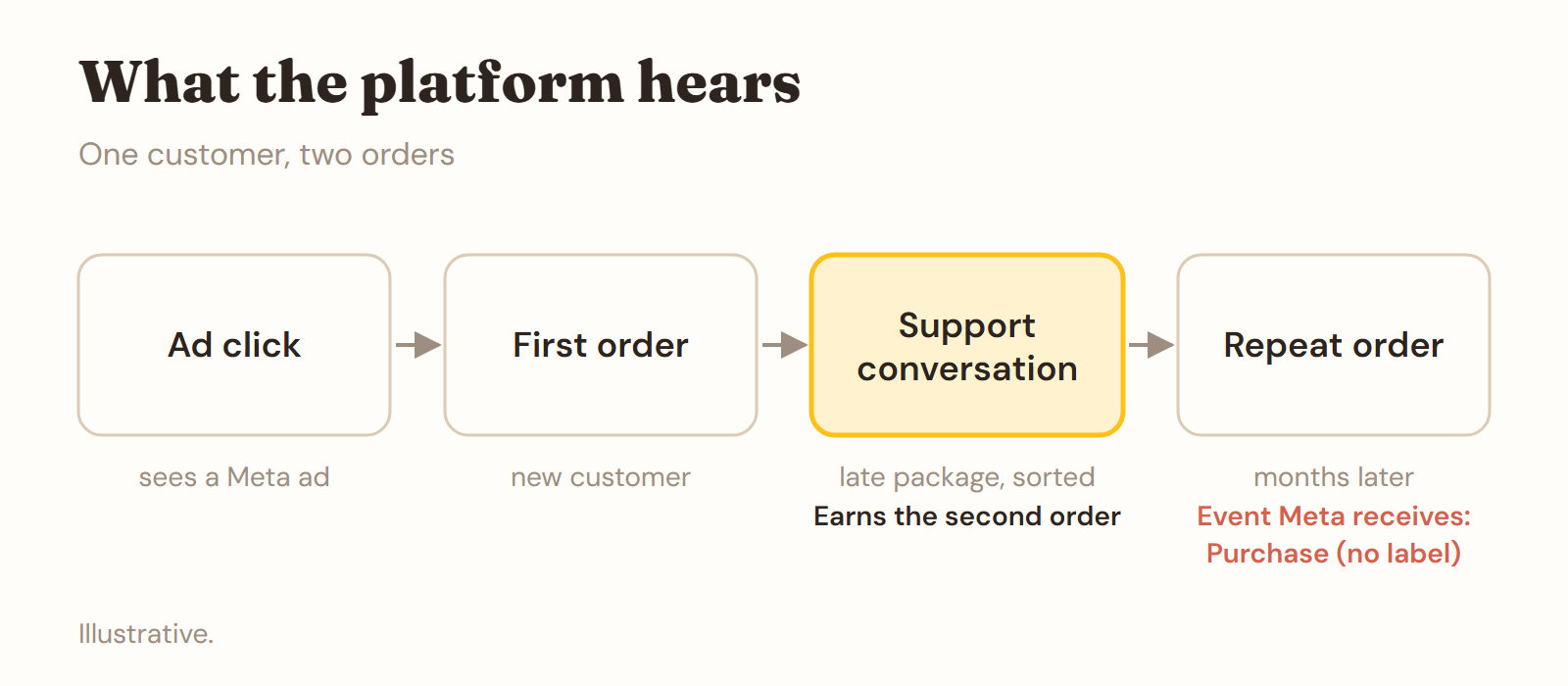
Say Meta reports 250 purchases from last month’s campaigns and a ROAS (return on ad spend) of 2.5. Check those orders in Shopify and you may find that 100 of them came from repeat customers: one because an agent sorted out a late package last spring, another because your follow-up email arrived the week they were running low. They clicked an ad on the way back to the store, and Meta received a purchase like any other.
That affects your acquisition cost first. With $10,000 in ad spend and 250 purchases, the dashboard puts your CAC (customer acquisition cost) at $40. But you only acquired 150 new customers, so the real cost is about $67 each.
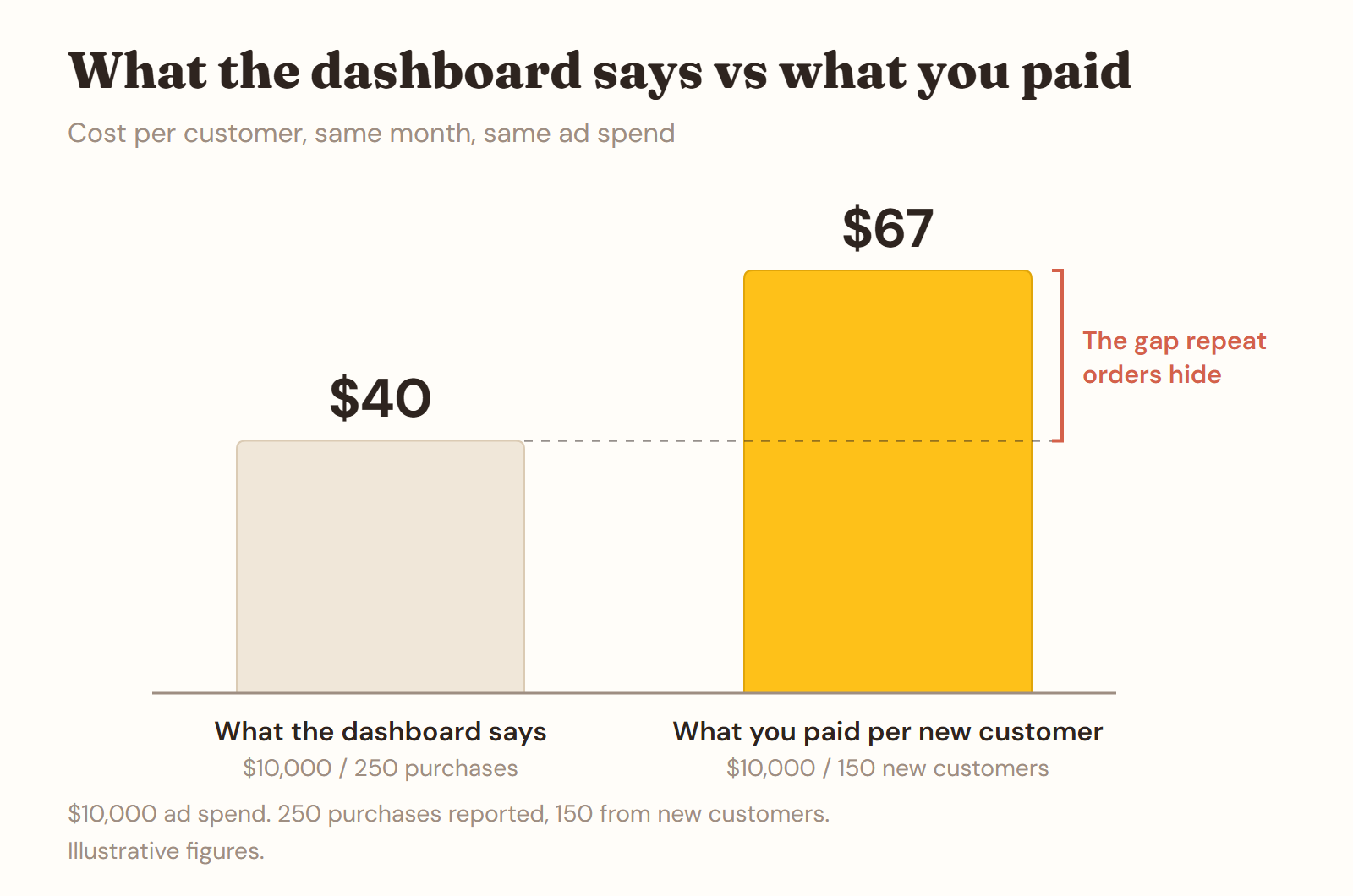
The $67 is the number your LTV (customer lifetime value) math should run on. HumanTouchCX’s guide to the CX metrics every ecommerce founder should understand explains how much depends on the ratio between lifetime value and acquisition cost, and paying $67 for a new customer is a very different bet from paying $40.
The algorithm optimizes for the signal you give it
The second effect is on the campaigns themselves. Meta’s Advantage+ and Google’s Performance Max campaigns (their automated campaign types) learn from the conversions you send them to find more likely buyers. If every purchase counts the same, existing customers are an easy win: they already know the brand and your checkout, so they convert cheaply and help the algorithm hit its target.
So part of your budget can go to people who would have come back anyway.
What changes when you send new and returning separately
Send new and returning purchases separately and you get three things.
The platform can optimize for new customers
Meta can receive separate events for first and repeat purchases, so you can point acquisition campaigns at first purchases only. Google Ads has a new customer acquisition goal for Search, Performance Max, Shopping and Demand Gen campaigns that bids higher for new customers, or only for them, based on the existing customers you define (for example with a customer list or your conversion data). You can also exclude an up-to-date audience of existing customers from your acquisition campaigns.
You see the split in the ad platform itself
In Meta Ads Manager, you can add new and returning purchases as separate columns. In Google Ads, the new customer acquisition goal reports new-customer conversions. So cost per new customer and ROAS on new customers sit next to blended ROAS, where budget decisions are made.
You can see what repeat customers are worth
Once repeat orders are labeled, you can see how much revenue they bring in, how often people come back and what that does to lifetime value. That revenue becomes its own number, one that retention and support teams can claim.
Why LTV is the new ROAS
When we talked about acquisition costs with the HumanTouchCX founders, they described what a lot of brands end up doing: “It’s almost like everybody has decided to spray and pray. You spend so much money to acquire, to get that CAC, to get that person there. What then?”
ROAS tells you how much revenue came back for every dollar of ad spend this month. LTV asks a more useful question: what is a customer worth across everything they’ll ever buy from you, and what did it cost to get them?
That takes telling new and repeat customers apart: it gives you the real cost of a new customer ($67, not $40) and what those customers bring in after their first order.
What your support team is worth
When every purchase counts as an ad conversion, the work that created repeat orders drops out of the numbers: the personal reply that saved a delayed order, the sizing question answered before checkout, the return that went smoothly enough for the customer to order again. Those are the customer conversations you shouldn’t be trying to avoid, and none of them show up in the report.
With repeat revenue labeled, you can put it next to your support metrics for repeat buyers, like CSAT (customer satisfaction score), contact rate and resolution time. HumanTouchCX has argued that customer service might be your most overlooked sales channel. This is how you show it, instead of support looking like a cost to cut.
How TrackBee sends new and returning customer data
TrackBee is server-side tracking for Shopify. We capture every conversion from your store’s server, enrich it with first-party data and send it to Meta, Google, TikTok, Pinterest, Snapchat, GA4 and Klaviyo. Every purchase we send also says whether it came from a new or a returning customer.
Meta receives separate NewCustomerPurchase and ReturningCustomerPurchase events, so you can optimize acquisition campaigns for first purchases and see both groups in Ads Manager.
Google Ads, TikTok and Snapchat get the same new and returning split, which you can use with Google’s new customer acquisition goal.
We keep an audience of your existing customers in Meta up to date every 5 to 15 minutes, so you can exclude them from acquisition campaigns without uploading lists.
Because the events are sent from your store’s server, purchases that browser pixels miss still reach the platforms, label included.
In TrackBee Insights you can see your cost per new customer next to your blended numbers.
If you want your ad platforms to know which customers on your Shopify store are new, you can set up new and returning customer tracking with TrackBee.
Frank de Vos works in marketing at TrackBee, server-side tracking for Shopify that catches the conversions browser pixels miss and tells Meta, Google and TikTok which orders come from new customers.